
A look at consolidation, deployment data, and market trends across sales software, and what they reveal about the durability of investing in this sector.
Date
08/11/2026
Author
Antonio Di Meglio, Juhao (Leon) Li, Dahlia Mankovich
The Central Claim
Sales software has grown into one of the largest and most closely watched subcategories of enterprise technology, and its evolution over the past several years offers a useful lens for evaluating how artificial intelligence is reshaping software investment more broadly. The category spans a wide range of functions, from customer relationship management and pipeline tracking to newer tools built specifically around conversation analysis, coaching, and outbound automation, and it has continued to attract substantial investment even as broader software markets have faced pricing pressure tied to AI adoption. Two distinct models have emerged of integrating AI into sales software.
The first is a replacement model, in which AI agents are designed to autonomously execute prospecting, outreach, and qualification with minimal human involvement, typically priced against the cost of a human hire rather than a conventional software seat. The second is an augmentation model, in which AI is used to improve the performance of an existing human seller through real-time coaching, conversation intelligence, and deal-risk analysis, without removing the seller from the process.
The distinction determines how these companies are priced, who can buy them, and whether their deployments survive. The available deployment and market data point to a divergence in durability between the two, and to augmentation as the model where the more defensible businesses are being built. This paper traces that divergence, the evidence for it, the buying behavior that corroborates it, and where within the category the resulting opportunity sits.
The Augmentation vs. Replacement Divide
Adoption rates alone do not distinguish between the two models, since both have seen substantial uptake. A more useful measure is durability: whether deployments persist, deliver measurable results, and avoid being reversed within a short period. On this measure, the available data show a consistent pattern favoring augmentation.
Adoption and failure rates
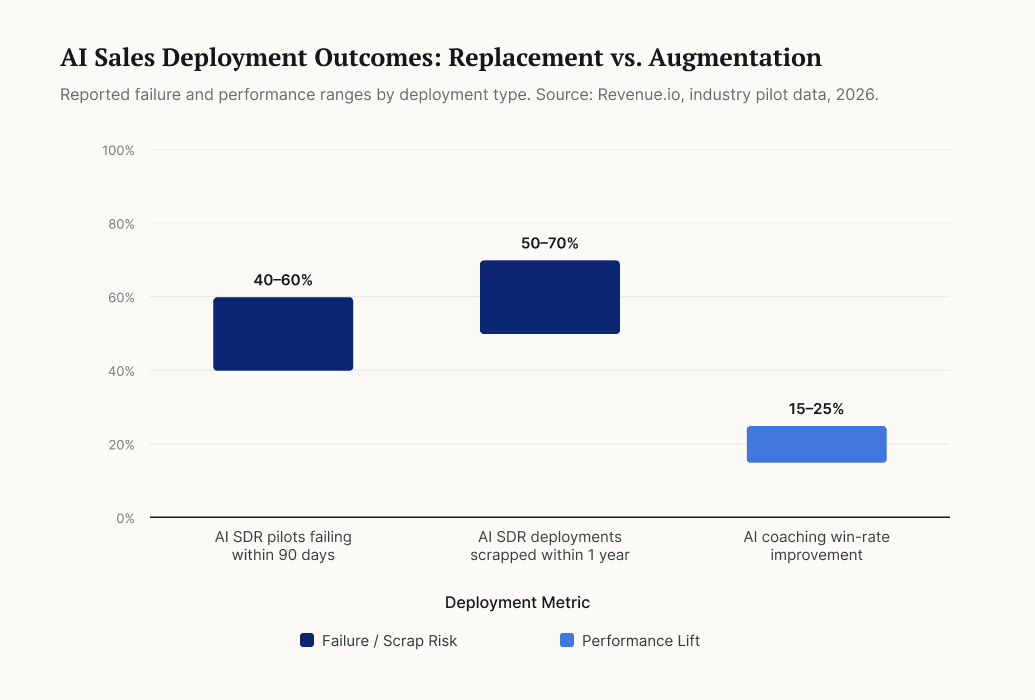
An estimated 41% of B2B sales teams currently run AI SDR agents in some form, indicating meaningful enterprise interest in the replacement model. However, deployment outcomes have not matched this level of adoption. Between 40% and 60% of AI SDR pilots are reported to fail within the first 90 days, and over a longer horizon, 50% to 70% of deployments are ultimately discontinued within a year, a rate roughly double that of the human SDR roles they were intended to replace. These figures appear across multiple independent industry analyses covering 2025 and 2026 deployments, which suggests the pattern reflects a structural characteristic of the model rather than isolated implementation issues.
Pricing structure and addressable market
The pricing logic of each model helps explain this divergence. Replacement tools are generally priced against the fully loaded cost of a human hire, with some vendors charging upward of $50,000 to $60,000 annually, positioning the product as a direct substitute for headcount. This pricing approach narrows the addressable market to buyers specifically seeking to reduce sales headcount, rather than the broader population of companies operating a sales function.
Augmentation tools, by contrast, are typically priced on top of an existing sales team's budget and tied to measurable performance improvements such as win rate or ramp time, rather than to headcount reduction. This difference in structure corresponds to a difference in demonstrated outcomes: AI coaching tools have been associated with win-rate improvements of 15% to 25%, alongside comparatively low reported deployment risk relative to replacement tools.
Behavioral and market signals
One relevant data point is the hiring behavior of AI-forward companies themselves. OpenAI and Anthropic, both operating at the frontier of applied AI capability, have continued to hire human SDRs through 2026 rather than fully automating the function. This is a useful indicator, since these organizations are arguably best positioned to implement full automation if the underlying technology supported it at scale. Broader commentary on B2B sales technology in 2026 similarly describes AI as most effective in preparation, research, and account prioritization tasks, with relationship management and deal closing remaining primarily human functions in complex enterprise sales cycles. Hybrid deployment models, which pair AI-driven top-of-funnel work with human-led qualification and closing, have also shown favorable cost outcomes relative to fully automated approaches, with one industry benchmark reporting a cost per qualified opportunity of approximately $487 for human-only pods compared to $224 for hybrid pods, a reduction attributable to augmentation rather than full automation.
Taken together, the two models carry materially different risk profiles. Replacement is constrained to a narrow buyer segment defined by headcount reduction, has shown a high rate of deployment failure, and is evaluated against a standard it has not consistently met. Augmentation addresses a buyer base already operating a sales function, has demonstrated measurable returns, and has shown lower observed deployment risk.
Consolidation as Validation
Merger & Acquisition Activity
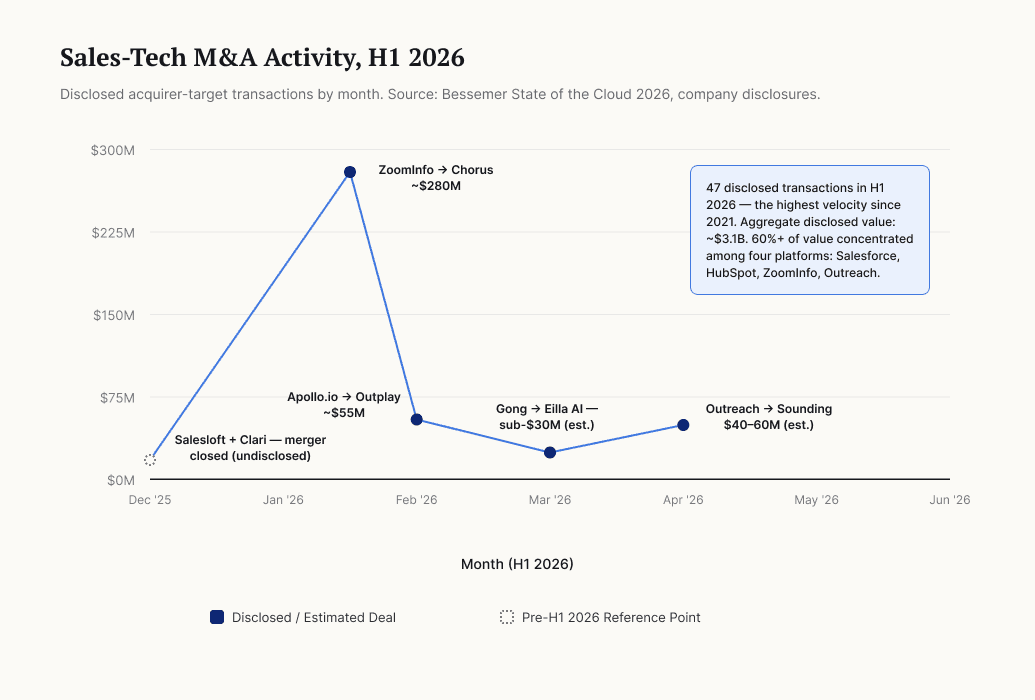
Consolidation activity within sales software provides additional evidence relevant to this discussion. Sales technology M&A activity reached its highest level since 2021 in the first half of 2026, with 47 disclosed transactions recorded in that period, and more than 60% of total deal value concentrated among four acquiring platforms. Recent examples include ZoomInfo's acquisitions of Chorus.ai and several smaller sales intelligence companies, Clari's acquisitions of DealPoint and Wingman, and the merger of Salesloft and Clari in December 2025.
The pattern in these transactions is informative. Acquirers have generally targeted companies with proprietary data assets, such as conversation records or coaching workflows, rather than standalone automation features. Over the same period, established platforms including Salesforce, HubSpot, Outreach, and Salesloft built AI SDR-style automation natively into their existing products rather than acquiring it.
Under this pattern, replacement-style automation is treated as a feature to be built, while augmentation-style data and coaching capabilities is treated as an asset worth acquiring.
Buyer preference reinforces the same consolidation pressure. Approximately 78% of software buyers report a preference for working with fewer vendors, and 84% report a preference for a single unified platform over multiple point solutions. These preferences create an incentive for platform providers to consolidate differentiated capabilities under one roof, particularly capabilities built on proprietary data that would be difficult to replicate internally.
A high acquisition rate may reflect a category maturing around durable business models, or an inability of standalone companies to compete independently over time. For early-stage capital the two readings converge on the same practical conclusion: consolidation corresponds to higher acquisition multiples and a broader set of exit paths, which is a favorable dynamic for capital deployed at seed and early growth even if the number of independent companies contracts.
What incumbents cannot build
The build-versus-buy split points directly to where early-stage opportunity sits. Incumbents build what is cheap to build and acquire what is not, and what they consistently acquire is proprietary conversation data and coaching workflows. That is direct evidence of a capability the best-resourced platforms still choose to pay for rather than reproduce, which is the same capability a focused new company is positioned to build. Three constraints keep the largest platforms from closing that gap directly.
The first is architectural. The established platforms are built on retrospective analysis; they process the recording, surface the insight after the call ends, and their advantage is a corpus of historical calls a new entrant cannot match. That corpus does not transfer to live, in-call analysis, which is a latency and interface problem running on a different stack.
The second is data adjacency. The incumbent flywheel compounds only within the mode that generates it. A scored practice call that never involved a real buyer produces data a library of completed calls cannot backfill. The third is incentive. A platform priced per seat has a structural disincentive to build products that reprice away from seats, or compress the headcount its pricing depends on. This is a reluctance that is durable precisely because it protects the core model. What these three establish is a window in which an early stage focused company can accumulate a proprietary interaction-data asset in a mode the incumbents have not built toward.
Where the Promising Sub-Segments Sit
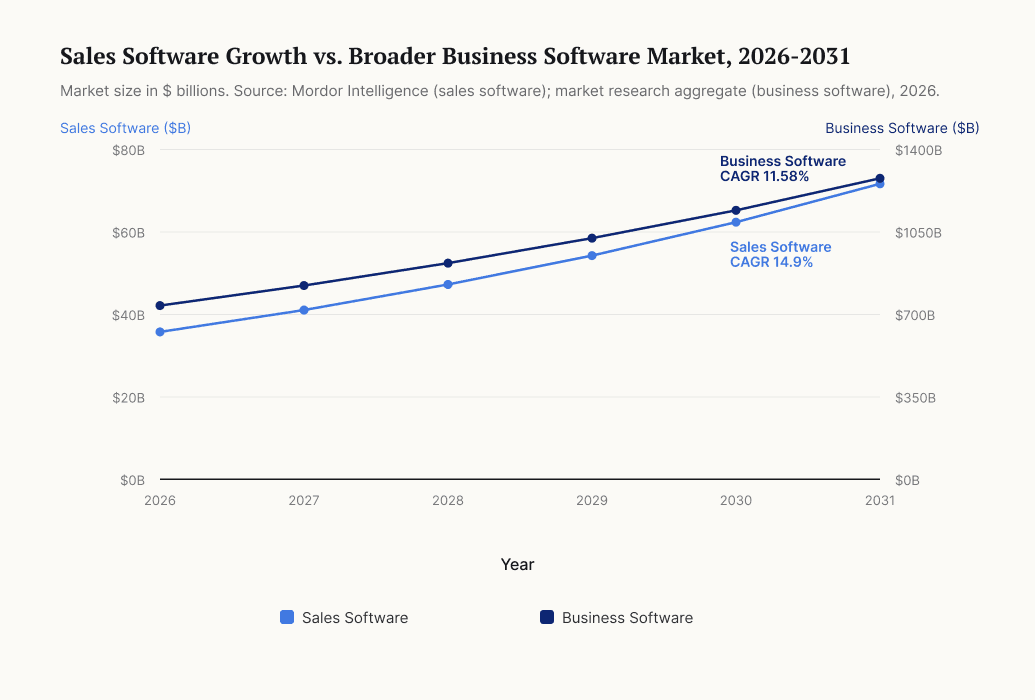
The sales software market was valued at approximately $35.9 billion in 2026 and is projected to reach $71.8 billion by 2031, a compound annual growth rate of roughly 14.9 percent. That figure is notable in context. Roughly $300 billion in software market capitalization was erased in early 2026 as public markets repriced per-seat licensing models against AI-driven changes in software economics. Sales software did not follow. The most plausible explanation is the pricing structure described earlier: tools priced against measurable performance outcomes rather than seat count are not directly exposed to the mechanism driving the correction.
Growth within the category is concentrated further still. Sales analytics software is projected to grow from $5.5 billion in 2026 to $12.5 billion by 2033, a CAGR of approximately 12.4 percent, and sales engagement software from $5.8 billion in 2026 to $14.6 billion by 2032, at approximately 16.7 percent. Both figures track at or above the broader category rate, and both sub-segments are oriented toward augmentation.
Conversation intelligence and coaching
Conversation intelligence has developed into one of the more established sub-segments within augmentation-style sales software. Gong, the category's most prominent independent company, reported revenue of approximately $500 million in 2026, up from roughly $332 million in 2024, alongside more than 55% year-over-year growth in its most recent reported quarter. The company holds an estimated 40% share of the enterprise revenue intelligence market and counts more than 4,000 customers, including large enterprises such as LinkedIn and Shopify, paying between $50,000 and $500,000 annually for multi-seat deployments. This scale demonstrates that enterprise buyers are willing to pay substantially for tools that improve the performance of existing sales teams, rather than only for tools that reduce headcount.
Within this sub-segment, a related and more recent trend has emerged around real-time coaching delivered during live sales conversations, rather than only through post-call review. CCV's portfolio includes Curvo, a company operating in this space, which provides in-the-moment coaching and deal intelligence during live sales calls rather than relying solely on retrospective call analysis. This distinction between real-time and retrospective coaching reflects a broader direction within the conversation intelligence category, as the underlying technology has matured to support live analysis in addition to historical review.
Sales engagement and readiness
Sales engagement platforms, which manage outbound cadences, sequencing, and pipeline workflows, represent a second sub-segment with substantial scale. Outreach and Salesloft remain the two largest platforms in this category, both valued in the billions of dollars, and both have expanded their product lines to include forecasting and AI-driven features in response to buyer demand for consolidated tooling.
A newer category has developed around sales readiness and simulation, which focuses on preparing sales representatives for live conversations through practice and rehearsal rather than analyzing calls after they occur. CCV's portfolio also includes Quotain, a company operating in this space, which provides simulated buyer conversations and scored practice calls to reduce the time required for new sales representatives to reach full productivity. This sub-segment addresses a specific augmentation use case, namely onboarding and skill development, that is distinct from both live coaching and post-call analysis, and reflects a broader trend of augmentation-style tools expanding into earlier stages of the sales representative's development cycle.
Conclusion
The replacement model retains a real niche in high-volume, low-complexity outbound, where the cost of a failed interaction is low enough that automation clears the bar. But that is a narrower claim than the adoption figures imply, and it describes the ceiling of the model rather than its trajectory. Across the evidence assembled here, in deployment persistence, in breadth of addressable buyer, and in what acquirers have paid to own rather than build, augmentation is the more durable of the two, and that durability appears structural rather than incidental to the current state of the technology. For an early-stage investor, the more useful conclusion is where that durability leaves room to enter: not in the consolidated enterprise tier, but in the interaction modes the incumbent platforms have not built toward, where a proprietary data asset can still compound from zero.
For questions or inquiries, please contact us at team@coeuscollective.xyz.