
A diligence framework CCV uses to separate real AI-native hardware companies from those merely riding the narrative, built from patterns observed across its own portfolio and deal flow.
Date
07/22/2026
Author
Antonio Di Meglio, Juhao (Leon) Li, Dahlia Mankovich
Software-Enabled Hardware
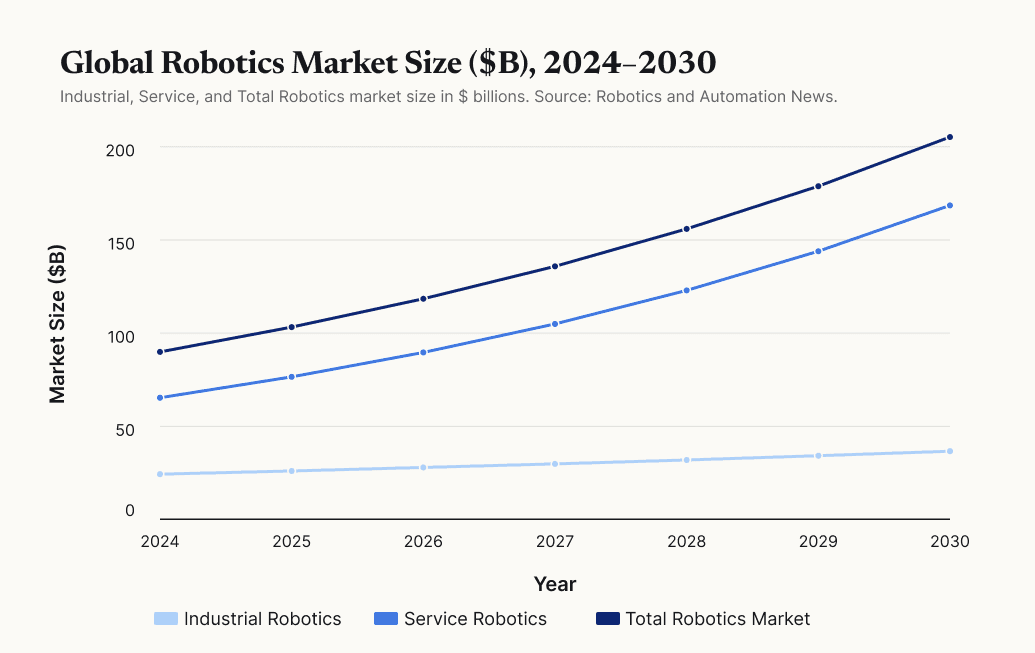
Software-enabled hardware, physical products whose defensibility comes from a software layer rather than the physical product alone, is now visible everywhere. The same underlying pattern that defines the world's largest technology companies also defines the pitches CCV sees for early-stage deep tech companies. This is not a coincidence of timing; it is evidence of a structural shift in how hardware companies now compete, one CCV has tracked through its own portfolio work as much as through broader market data. At its core, software-enabled hardware describes companies where hardware functions as the delivery mechanism while software functions as the value engine. Defensibility comes from the software layer, not from manufacturing, materials, or mechanical design alone. This is a structural pattern that shows up in climate technology, robotics, health devices, and industrial equipment alike. The market data corroborates what CCV has observed directly, especially in the robotics industry. Industrial robots, the traditional hardware-first category, are lagging by growing at roughly 7 percent annually, while service robots, which depend on AI for navigation, perception, and decision-making in unstructured environments, are growing more than twice as fast at roughly 17 percent. That gap indicates that it is the software layer, not the mechanical build, that is driving the faster-growing half of the robotics market.
Why This Pattern Has Succeeded
Pairing software with hardware succeeds economically for four well-established reasons.
Margin Transformation: Hardware sold on its own carries structurally thin margins, but layering recurring software revenue on top pushes blended margins from around 20 to 40 percent toward 50 percent or higher.
Create Value After Shipment: Software updates allow a company to improve or monetize a product after it has already shipped, without re-manufacturing it. This shifts the economics of hardware from a single point-of-sale transaction toward an ongoing relationship with the installed base.
Data Flywheel: Deployed hardware generates data that improves the software running on top of it, which improves the hardware's real-world performance, compounding over time. This loop is difficult for a competitor to replicate without an equivalent base of deployed hardware.
Switching Costs: Replacing a hardware-software stack requires retraining a workflow, not just canceling a subscription. Hardware drives initial acquisition, software creates lock-in, and the surrounding ecosystem defends the relationship over time.
These four mechanisms are now widely understood, and together they explain why software-enabled hardware has become the default framing for ambitious hardware businesses.
The Problem with this Broad Category
That widespread understanding is precisely what has created a new problem. Because building a basic AI or software layer has become inexpensive and fast, nearly every hardware company today claims some form of software differentiation. This ubiquity is exactly what makes "software-enabled hardware" too broad a category to function as an actual investment filter. If the label applies to nearly everything, it distinguishes almost nothing.
The sharpest expression of this problem is AI-washing: the practice of adding a thin, cosmetic artificial intelligence layer to an otherwise conventional product to appear more innovative than the underlying technology actually is. In April 2025, the SEC and Department of Justice brought their first joint AI-washing enforcement action, charging the founder of Nate Inc. with misleading investors about the company's AI capabilities. A more extreme case followed with Builder.ai, once valued above $1.5 billion, which collapsed into bankruptcy in June 2025 after investigators found its "AI-powered" development process was, in large part, human developers working manually behind the scenes. As software-enabled hardware has become the dominant framing for hardware pitches, the category has grown crowded with companies applying a superficial layer without creating genuine value.
Because software-enabled hardware is too broad a category to serve as an actual investment filter, CCV has developed a narrower lens for identifying which companies within this category are creating genuine, structural value.
Narrowing the Scope
If nearly every hardware company today claims some form of AI or software integration, the relevant investment question is no longer whether a company has a software layer. It is whether that software layer is doing something a basic control or optimization system could not.
Many leading hardware companies already use software to create meaningful performance gains, coordination advantages, and operational flexibility. Tesla's over-the-air updates continuously improve vehicle functionality after purchase. John Deere's See & Spray uses computer vision to make agricultural spraying more precise. Anduril's Lattice integrates sensors, autonomous systems, and operators into a unified operational picture. These are important examples of software making existing categories of hardware more capable. The distinction, for our purposes, is that the software improves how the hardware performs within an already-defined output category. It does not determine what the hardware is able to produce in the first place.
A smaller, more interesting category of deep technology companies uses software differently. Rather than coordinating an existing output, it makes an entirely new output economically possible, starting from an input incumbent hardware cannot process at all.
CCV refers to this category as AI-Native Extraction Platforms: hardware systems that make an economically inaccessible physical or informational input newly viable to process, using an AI layer. The result is a new source of supply: a fuel, chemical, or material, a diagnostic answer, or another category of output entirely. The framework rests on one primary condition that separates genuine AI-native value creation from AI-washing, and two supporting conditions.
The Framework
Primary Condition: AI-Native Unlock
An AI or machine learning layer is the precondition that makes processing the input viable at all, not a feature that improves an already-functioning process. The test is binary: remove the AI layer, and the system reverts to a categorically different, substantially lower-value business, not a modest degradation of the same business. This is what separates a load-bearing AI layer from a cosmetic one, and it is the direct answer to the AI-washing problem.
Supporting Condition: Resistant Input
The input is too heterogeneous, dilute, contaminated, or physically constrained for conventional hardware to process economically — and that resistance is precisely what makes the AI load-bearing. If the input were tractable, conventional processing would already reach it and no unlock would be required. Resistance is not limited to physical materials: an input can be a data set too fragmented or voluminous to interpret at scale, or information that exists but has never been extractable previously.
Supporting Condition: New Output
The capability produces a supply that did not previously exist in economically viable form, not a cheaper version of an existing one. This is the condition that separates AI-Native Extraction from ordinary process optimization. A system that uses AI to process a resistant input but yields more of an output the market already has — lower-grade ore refined into ordinary copper, say — is optimizing a supply chain, not creating one. New Output rules that case out.
Applications of AI-Native Extraction
This framework is especially applicable in a handful of sectors. In materials science, it helps separate companies genuinely discovering or synthesizing new compounds from those simply optimizing existing formulations with better tooling. In climate technology, it distinguishes ventures extracting or converting previously unusable feedstocks, carbon streams, or waste inputs from those making incremental efficiency gains on processes that already work. In select healthcare and diagnostic applications, it separates platforms that make a class of measurement or intervention possible for the first time from those that simply speed up an existing workflow.
This framework is particularly useful at the early stage when revenue is minimal, the team is small, and the physical product is often unproven. Whether the AI layer is solving a problem that was previously intractable, not merely one that was previously inconvenient, is one of the strongest structural signals of an early stage deep tech company.
CarbonBridge
CarbonBridge, a CCV portfolio company, is building a modular bioreactor platform that converts waste gas into industrial chemicals and fuels, using a machine learning control system that determines how efficiently any given microorganism can perform the conversion. A bioreactor is a vessel that creates a controlled environment (regulating temperature, acidity, gas levels, and nutrients) in which microorganisms grow and produce a desired output, a technology already used industrially to manufacture products like vaccines and enzymes at scale. Gas fermentation applies this same process to waste gases such as methane, converting them into usable chemicals rather than relying on sugar or biomass feedstocks.
The reason this has not been done at scale before comes down to basic physics. Gas dissolves poorly in liquid, and in a conventional stirred-tank bioreactor, less than 0.1 percent of available methane is actually accessible to the microorganisms responsible for converting it. Waste gas is sitting on top of the water rather than dissolving into it, and conventional bioreactor designs have no way around this constraint. CarbonBridge's Direct Gas Fermentation bioreactor solves this with a planar, porous substrate design built specifically to get gas to the microbes, delivering more than a 500 percent increase in microbial productivity and over 80 percent greater energy efficiency than conventional systems. The design is modular, scaling by stacking additional units, and has already demonstrated an 80-fold scale-up from lab to pilot.
Getting the gas to the microbes, however, only solves half the problem. Every microbial strain behaves differently depending on the substrate it is running on, and tuning a strain to perform well on direct gas rather than sugar requires constant adjustment of the reactor's operating conditions. This is the job of CRUCIBLE, CarbonBridge's four-layer machine learning control stack, trained on more than 700 reactor-hours of operating data, which learns how to tune each loaded microbe to peak performance on a direct-gas substrate. The reactor does not run without it — CRUCIBLE is not an optimization layer sitting on top of an already-working process, it is the reason the process works at all.
The result is a platform capable of producing methanol, biosurfactants, and biodegradable plastic from a feedstock that has effectively been free and stranded until now. Waste gas has always existed; what has not existed is an economical way to turn it into something valuable. CRUCIBLE continues to improve with every additional reactor-hour of operating data, meaning the platform's ability to unlock new products from new microbial strains compounds the longer it runs.
Orbital Industries
Orbital Industries designs entirely new physical materials using a generative AI model, rather than discovering them through the trial-and-error process that has defined materials science for decades. Materials science has traditionally worked by synthesizing a candidate compound, testing it, adjusting the formula, and testing again, a cycle that can take years to produce a single usable material. Orbital's foundation model, Orb, was trained on a proprietary dataset spanning chemistry and physics, and it searches computationally across enormous spaces of possible molecular structures, predicting which configurations will perform under a given set of conditions before a single physical sample is ever synthesized.
The company's first commercial target is one of the more punishing environments in modern infrastructure: the hot, low-concentration exhaust air produced by AI data centers. Conventional carbon capture materials were built for cooler, more concentrated air streams, and simply fail to perform when the input is this hot and this dilute. Orbital's AI-designed materials are engineered specifically for this narrower set of conditions, sitting inside modular hardware units that circulate exhaust air through the material bed and capture carbon that existing sorbents cannot touch.
Removing the AI here does not leave Orbital with a slightly worse product. It leaves Orbital with no product at all, because the material at the center of the business does not exist without the model that generated it. Orb is not refining a compound humans already found, it is the mechanism producing candidates no human research process identified in the first place. The result is a class of materials that had no prior equivalent, now deployed inside Orbital's own hardware and expanding into new applications, cooling fluids, catalysts, water treatment, as the underlying model continues to search a design space no lab could cover manually.
Reusable Framework
AI-Native Extraction Platforms are not presented here as a prediction about a specific vertical. They are a reusable framework for evaluating where genuine value creation is occurring within a broader, increasingly crowded software-enabled hardware category.
CarbonBridge and Orbital Industries operate in unrelated industries, spanning bio-industrial chemistry and advanced materials, but both satisfy the same conditions. This is evidence that the framework identifies a structural pattern, rather than describing a single-industry trend.
This is also what makes the framework a practical diligence tool, and one that directly answers the AI-washing problem raised at the outset of this paper. Only companies that satisfy the primary condition, reinforced by strong supporting conditions, represent the category CCV considers genuinely novel.
AI-Native Extraction is the specific lens CCV applies when evaluating early-stage deep tech opportunities within its broader thesis of investing in the infrastructure of the new economy, offered here as a tool other investors and founders can apply directly to their own diligence.
For questions or inquiries, please contact us at team@coeuscollective.xyz.